
gain
A fast variation of Ken Perlin's gain function developed by Christophe Schlick.
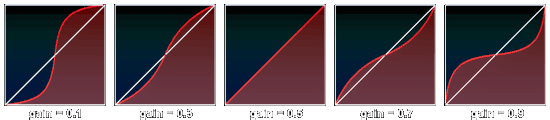
- gain(g, x)
- Returns the given value with a gain function applied to it.
COPY/// @func   gain(g, x)
///
/// @desc   Returns the given value with a gain function applied to it.
///
///         If x varies over the [0,1] interval, then the result also
///         varies over that interval. The 0 and 1 endpoints of the
///         interval are mapped onto themselves. Regardless of the value
///         of g, all gain functions return 0.5 when x is 0.5. Above
///         and below 0.5 the gain function consists of two scaled-down
///         bias curves forming an S-shaped curve.
///
/// @param  {real}      g           gain
/// @param  {real}      x           value
///
/// @return {real}      adjusted value
///
/// GMLscripts.com/license

function gain(g, x)
{
    var p;
    p = (1 / g - 2) * (1 - 2 * x);
    if (x < 0.5) return x / (p + 1);
    return (p - x) / (p - 1);
}
Contributors: xot
GitHub: View · Commits · Blame · Raw